01
Profile
Six answers, adapted from validated instruments, describe how you decide.
Five perspectives to inform your decisions. Ten initial questions lay the foundations for your board; your conversations and feedback keep enriching it.
Meet Five Peers and your personal board in a few seconds.
Create my boardThe video could not start. Open the video
Your board is not drawn at random and it is not a role-play. Twelve situations adapted from published studies bring out the way you decide. Three seats are common to everyone: contradiction, numbers, pre-mortem. The other two are chosen from your answers, by a written rule our server holds.
A wrong hint from the user can cost an AI assistant up to 27% of its accuracy: it follows you.
Sharma et al., Towards Understanding Sycophancy in Language Models, 2023Eleven AI models approved what users did 50% more often than people did.
Cheng et al., 2025, preprintLess than an hour of training in a reasoning method improved forecast accuracy by 6 to 11%.
Chang, Chen, Mellers & Tetlock, Judgment and Decision Making, 2016The same person's appetite for risk varies about seven times more from one domain to the next than between two people. Hence a board composed for you.
Blais & Weber, Judgment and Decision Making, 2006Five seats make their case. The report lays out scenarios, sources and what would change their views.
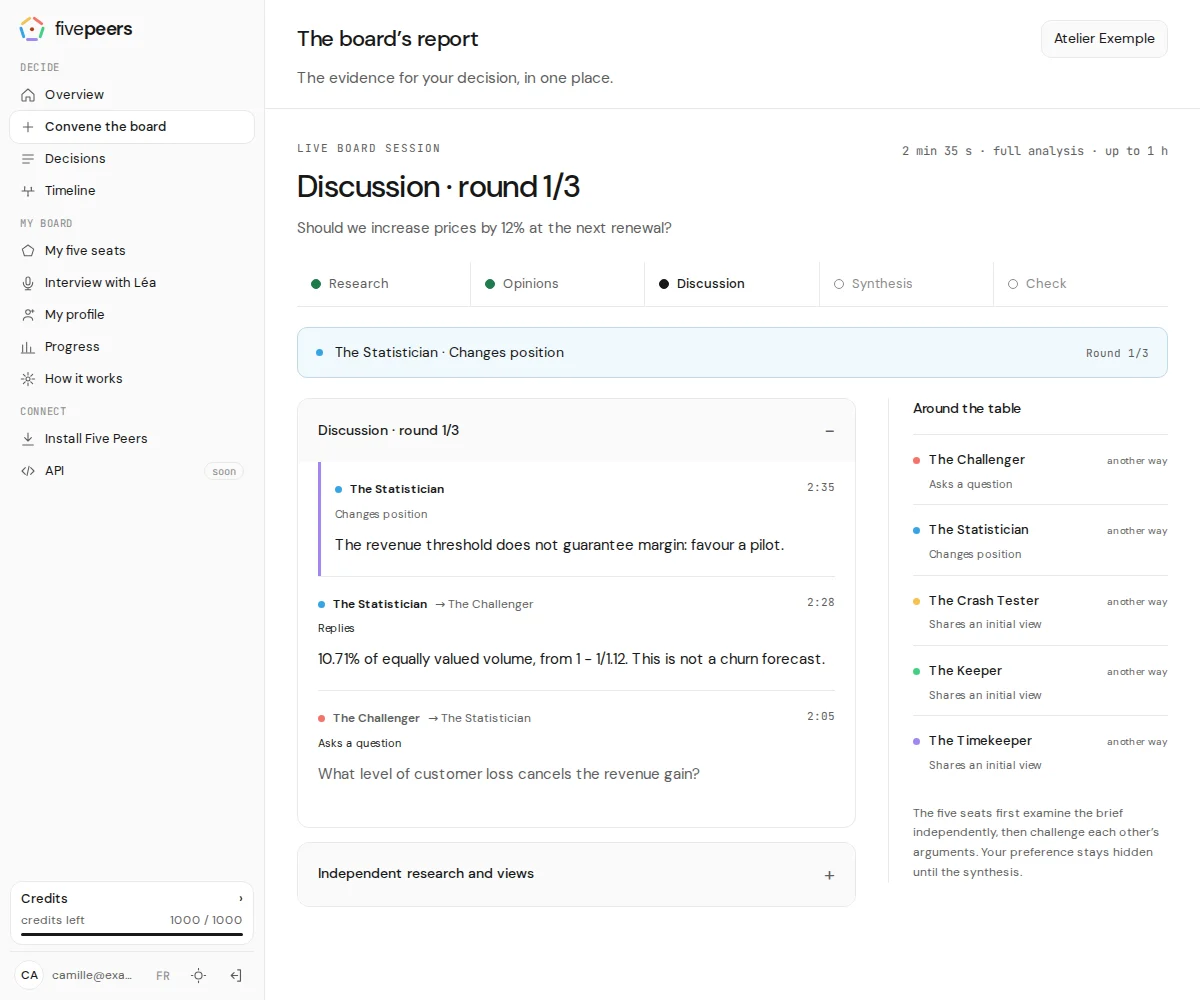
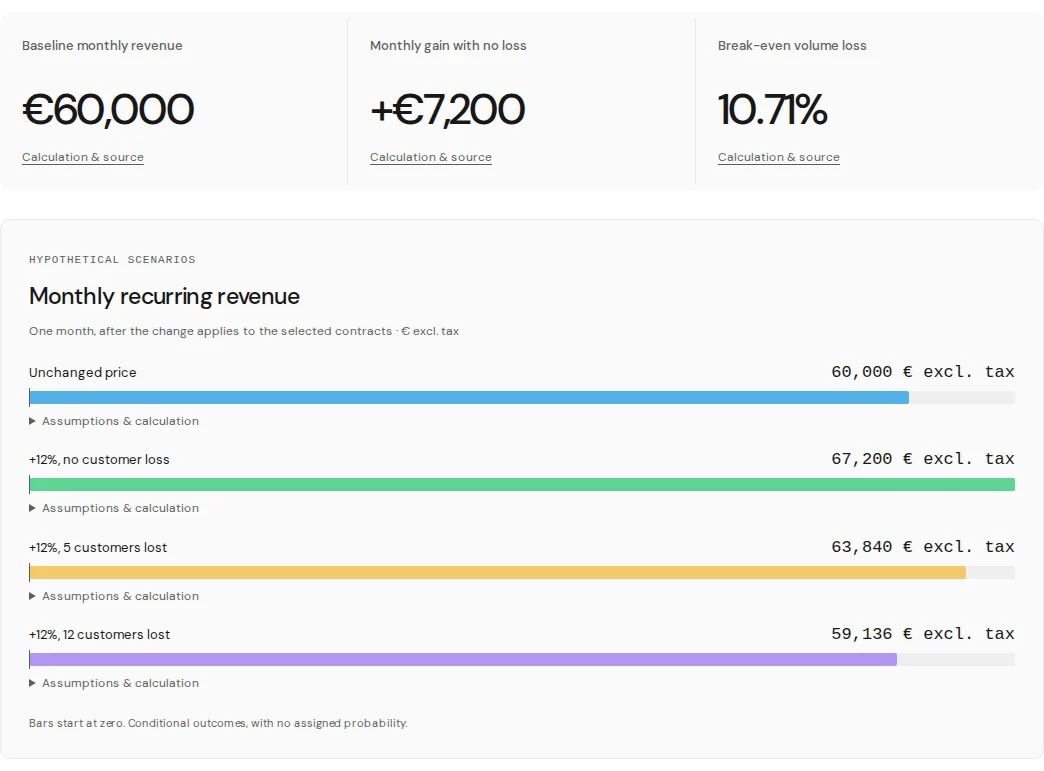
Claude gives you an answer. Your board gives you the questions that settle it.
The five questions of this example
| Judged on 20 decisions | Model alone | With Five Peers |
|---|---|---|
| Says it is a good idea | 7 yes, 5 unclear | 0 |
| Decides for you | 3 yes, 7 unclear | 0 |
| Asks for a precedent or a base rate | 1 yes, 2 unclear | 14 yes, 3 unclear |
| Challenges how you framed it | 20 | 20 |
The four examples above are single runs, shown as returned and shortened. Claude alone is Claude Sonnet 5.5, with no connector and no instructions. The board statements are what the Five Peers connector returns to Claude, written by our server. The three labels under each answer come from an independent judge, Jev (TypeSafe), answering yes/no questions.
The table is our quality bench: 20 leader decisions written by us with a built-in bias, same model on both sides (gpt-5.5, not Claude), equal length, same judge. Limits: our own cases, one run, one model, one judge. A first signal, not a published benchmark.
Context, memory and cheaper tokens all make an assistant better informed. None of them makes it disagree with you. Five Peers runs a fixed procedure on our server: it reads how you decide, seats the five methods that cover your gaps, and keeps a record the next session reads.
Six answers, adapted from validated instruments, describe how you decide.
A written matrix scores twelve methods against your profile. The five that cover your gaps take a seat.
Each seat applies its method to your decision, once, in the register you listen to.
What converges, what is left to check, and the tipping point.
The decision, its assumptions and its review date are written down. The next session reads them.
What changes between asking your assistant, staging a board of personas in a prompt, joining a peer group, and convening a board composed for you.
| Your assistant alone | A board of personas in a prompt | A peer group | Five Peers | |
|---|---|---|---|---|
| Who answers you | One voice, starting from your framing | Several voices, written by the same model on the spot | Several people, once a month | Five methods, each speaking once |
| How it is composed | Nothing is composed | You pick the characters | Whoever is in your group | From your six answers, by a published rule |
| What it rests on | The model's general training | Imitated famous voices | The members' experience | Twelve methods drawn from published studies |
| Same procedure every time | No | No, it depends on the prompt | It depends on the facilitator | Yes, it is run by our server |
| Memory of your decisions | Depends on the assistant's memory | None | In the members' heads | A register that is yours to export |
| Available | Right away | Right away | At the next meeting | Right away, in Claude or ChatGPT |
| At the end | An answer | A staged debate | Advice | Five objections and a debrief: you decide |
Categories, not brands: each column describes how that kind of solution usually works.